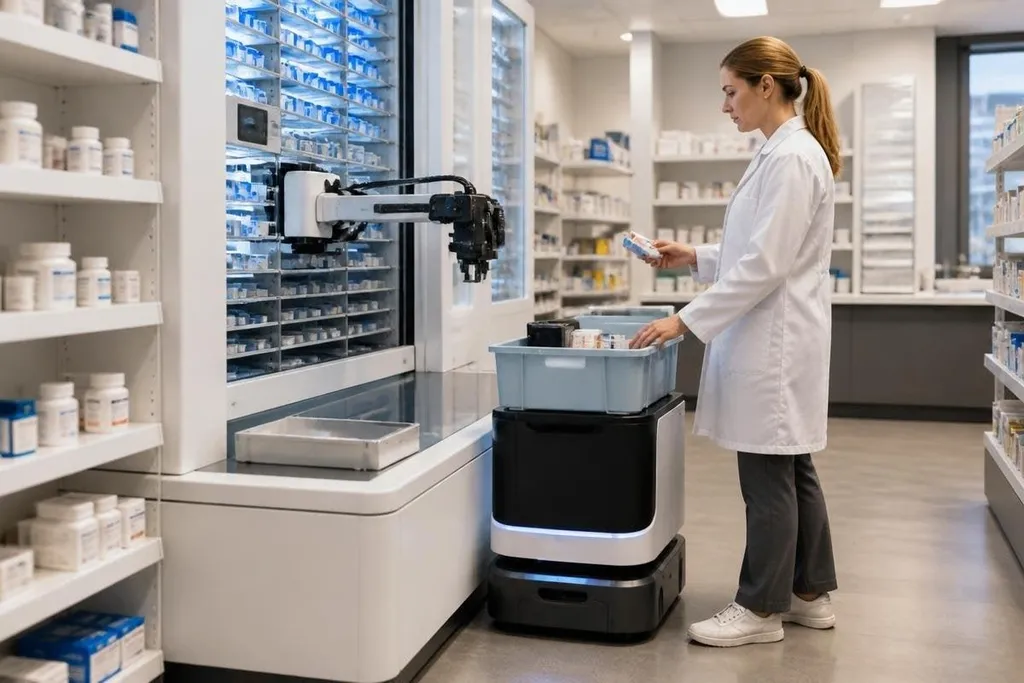
Pharmacy robots can sort medicines, store stock, and bring items to a pharmacist when needed. The business opportunity sits around those tasks: hardware, software, installation, service, and the data needed to keep the system working.
For a pharmacy owner, the useful question is where a robot removes repeated work without creating a new support burden.
- Automation: storage, counting, and order movement
- Revenue: sales, integration, service, and software
- Risk: safety checks, training, and system downtime
Where the work starts
Pharmacy robots usually work inside a wider process. Stock arrives, staff check it, the system stores it, a prescription enters the queue, and a pharmacist checks the result before supply reaches the patient.
That leaves several places for a company to sell equipment or services. A storage unit may handle stock movement, while a counting system prepares doses and software connects the robot with the pharmacy management system.
The connection matters because a robot without current stock data can create extra checks. Companies that build interfaces, test data exchange, and help pharmacies change their work may find a steadier market than companies selling hardware alone.
Hardware is one part of the sale
An automation company can earn money from the robot, its gripper or counting system, storage modules, barcode readers, and safety equipment. Each part has to fit the medicines, containers, floor space, and work steps found at the site.
That creates room for specialist suppliers. One pharmacy may need compact storage for packaged medicines. Another may need a system that moves bins between storage and a checking station. A third may need a robotic arm for a narrow, repeated task.
The sale also includes installation. A team must map the room, connect power and data, test the machine, and train staff. Those jobs need local support, which can create work for system integrators and maintenance firms.
Software and service may last longer
Hardware sales happen once. Software support and service can continue as long as the pharmacy relies on the system.
Useful software can track stock locations, flag an empty slot, send work to the next station, and record faults. It can also show when a pharmacist needs to check a result. Those functions matter because pharmacy work has little room for an unmarked error.
Service contracts can cover sensor checks, replacement parts, software updates, and remote fault checks. Any pharmacy that cannot use its automation system needs a clear manual process, a support number, and staff who know how to keep work moving.
A pharmacy technology buyer needs the robot’s task, price, staff role, and support plan before comparing a purchase with a service contract. Pharmacy robotics reporting from Robot24.com can place those details beside claims about new systems. The next step is checking where the machines still need people.
The hard limits
A robot doesn't remove the need for a pharmacist. Staff still check prescriptions, handle exceptions, answer patient questions, and deal with medicines that the system cannot store or identify.
Integration is another limit. Pharmacy software, inventory records, barcode rules, and payment systems may come from different suppliers. A project can run late when those systems cannot exchange the data the robot needs.
The unproven part is often the financial return. A vendor may show a smooth demonstration, but a buyer still needs site-specific figures for installation, service, training, downtime, and the work that remains after automation.
I'd start with one repeated task and a written failure plan before buying a full system.
A buyer's decision checklist
Use these questions before asking for a price:
- Map the task: count doses, store stock, move bins, or handle another defined job.
- Check the data: confirm which pharmacy and inventory systems can connect.
- Price the full project: include hardware, room changes, installation, training, service, and parts.
- Test exceptions: ask how staff handle damaged packs, unreadable labels, wrong stock, and power loss.
- Set a manual fallback: write the steps for safe work during downtime.
- Measure the result: record staff time, errors found, queue length, and system stoppages.
That record gives the pharmacy a basis for comparing vendors. It also shows where a service company can earn trust after the sale, because the work is tied to measured operating results rather than a demo alone.
Pharmacy robots create the clearest business opportunities where a supplier can connect a defined task to safe work, reliable support, and a cost the pharmacy can check.